

Structured Data Cabling & Network Points — Cat5e, Cat6 and Fibre, Tested and Certified.
Cabling that actually gets tested
The thing most clients remember about a poor data cabling installation isn’t how it was installed — it’s the call six months later when a link drops out, the IT team can’t identify which cable it is, and the original installer no longer picks up.
Barrow Electrical installs structured data cabling for commercial fit-outs and standalone data infrastructure projects across the UK. Cat5e, Cat6 and Cat6a horizontal cabling, fibre optic backbone, network points, patch panels and cable management. Every link is tested on completion to TIA/EIA or ISO/IEC standards, with full test documentation at handover. We do not hand over a cabling installation without test evidence.
Which cable do you actually need?
Cat5e
- 1 Gigabit
- 100 MHz
- Budget-constrained short-term projects. Adequate for current applications but limited headroom. Fine for refurbishments where the cabling will likely be replaced within five years.
Cat6
- 1 Gigabit (10Gb up to 55m)
- 250 MHz
- The right choice for most commercial fit-outs. Lower crosstalk than Cat5e, Gigabit as standard, upgrade headroom without re-cabling. Our default recommendation.
Cat6a
- 10 Gigabit to 100m
- 500 MHz
- Data centres, AV systems, high-density environments, future-proofed builds. Larger cable diameter needs bigger containment. Worth the extra cost when 10 Gigabit matters.
Multimode Fibre
- 10–100 Gigabit
- High
- Building backbone, inter-floor risers, between buildings on campus. Not for desktop connections — essential for high-bandwidth backbone.
Singlemode Fibre
- 100 Gigabit+
- Very high
- Long-distance campus links. Lower attenuation than multimode for runs beyond the multimode limit.
For most commercial fit-outs in 2026: Cat6 horizontal, fibre backbone if you have multiple floors or buildings, Cat6a if your application genuinely needs it. Don’t pay for Cat6a where Cat6 is sufficient — and don’t install Cat5e where you’ll regret it in three years.
What we install
Horizontal cabling (Cat5e, Cat6, Cat6a)
Fibre optic backbone and campus cabling
Network outlets and faceplates
Desk, floor box and wall-mounted outlets. Faceplates, keystone modules and surface boxes in the format your fit-out requires. Labelling matches the cable numbering and the test records.
Patch panels and comms cabinets
Rack and wall-mount cabinet installation, patch panel termination, cable management and labelling. The finished cabinet should be navigable by a maintenance engineer who has never seen it before. If it’s not, we haven’t finished.
Cable management
Containment design and installation: cable tray, trunking, conduit and basket. Coordinated with power containment to comply with BS EN 50174-2 separation requirements. On combined power and data fit-outs, containment is designed as one system, not bolted together afterwards.
Wireless access point cabling
Structured cabling to WAP positions. Power over Ethernet capable. Plenum-rated cable for above-ceiling routing in air-handling voids where required.
Testing: what we do and what you receive
Testing is the part that separates a cabling installation you can rely on from one you hope works. Every copper link we install is tested using a calibrated cable analyser before handover. For fibre, we carry out insertion loss testing and OTDR traces.
What the tests cover
- Wiremap — correct pin connections, no opens, shorts, reversals or crossed pairs
- Length — within the 90m permanent link limit
- Insertion loss — signal attenuation along the cable length
- Near-end crosstalk (NEXT) — interference between pairs at the same end
- Return loss — signal reflected back towards the transmitter
- Propagation delay and delay skew — for Gigabit and 10 Gigabit applications
What you get at handover
Full test results for every link: pass/fail summary, individual test data for any failed or reterminated links, and a schedule matching every cable number to its outlet and patch panel position. The test records come directly from the analyser — they have not been edited. If a link fails, we reterminate and retest. The replacement record replaces the failed one in the handover pack.
We do not hand over a data cabling installation without test evidence. If a contractor tells you that’s standard practice, it isn’t.
Data cabling as part of a wider fit-out or programme
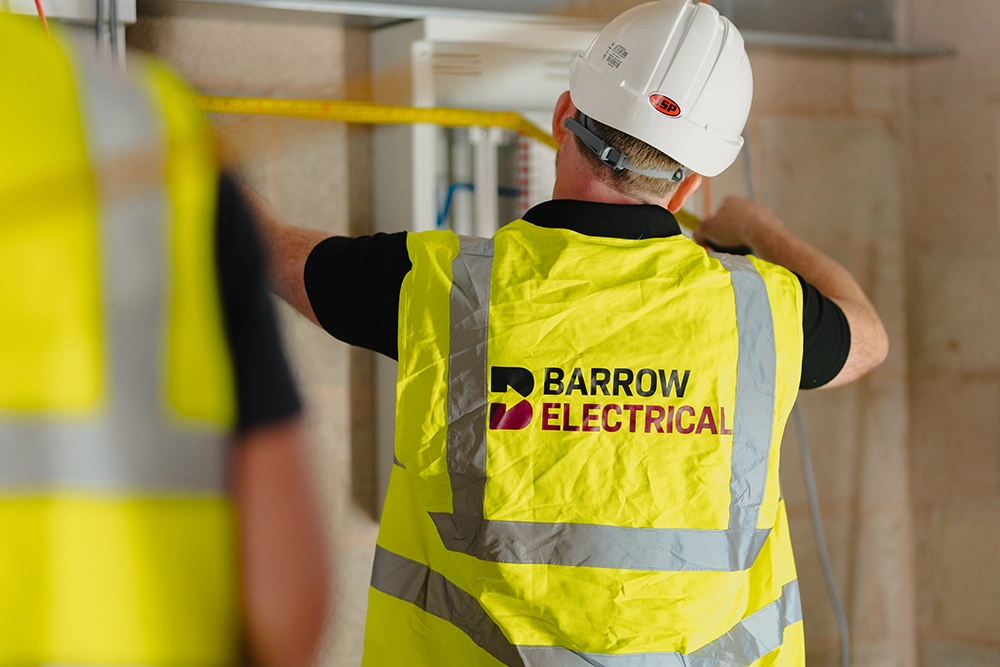
Data cabling is most efficient when it’s designed and installed alongside power rather than following it. When the same team does both, containment is coordinated from the outset, cable routes avoid conflicts and the programme runs cleanly. We deliver combined power and data fit-outs as standard.
Frequently asked questions
What’s the difference between Cat5e, Cat6 and Cat6a?
Cat5e supports Gigabit and is fine for most current applications, but it has limited headroom. Cat6 is the recommended default — better performance, lower crosstalk, future upgrade headroom. Cat6a supports 10 Gigabit at full 100m channel lengths and is the right choice for data centres and high-performance environments. The physical size of Cat6a cable is also larger, so containment needs to be sized accordingly.
Does data cabling need to be separated from power cables?
Yes. BS EN 50174-2 specifies minimum separation distances between power and data cabling to prevent electromagnetic interference. The required distance depends on the power cable type, shielding and the specific cable categories involved. We design the containment to comply from the outset — on combined power and data fit-outs this is significantly more efficient than treating the two trades separately.
Do you test every cable?
Yes. Every copper link is tested on completion using a calibrated cable analyser. Every fibre link is insertion loss tested and OTDR traced. The test results are provided in the handover documentation — pass/fail for every link, test data for any failures or reterminations. We do not hand over cabling without test evidence.
How long does a structured cabling installation take?
A typical 100-outlet office floor takes one to two days for an experienced team. We provide a programme estimate with the quotation based on the specific scope, access conditions and whether the installation is combined with other electrical works.
Can you work in occupied offices?
Yes. Above-ceiling and floor void work can usually be carried out during normal hours with minimal disruption. Cable pulling and outlet installation in open-plan areas is typically scheduled out-of-hours or at weekends where it would significantly affect occupants.
Can you add network points to an existing cabling installation?
Yes. We add outlets to existing structured cabling systems — new desk positions, room reconfigurations, equipment moves. Where the existing cabling is a different category to the new outlets, we advise on the performance implications before proceeding.
Request a quote
Tell us the building type, floor area or number of outlets you need and whether you have fibre backbone requirements. We’ll produce a fixed-price quotation based on a site visit or your floor plans.