

Commercial LED lighting upgrades - measured, designed and commissioned properly.
- Free initial review. We will say when the business case does not justify replacement.
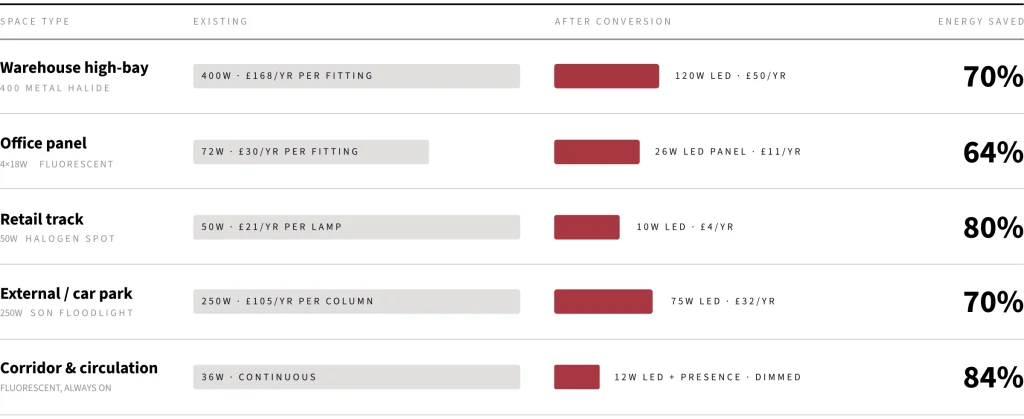
The same light, for a third of the load
Savings vary enormously by space type and hours of use, which is why a single blanket figure is meaningless. These are typical like-for-like conversions at 2026 UK commercial rates — your own figures come from the survey.
Designed, installed and commissioned by one contractor
Most disappointing LED projects are supply-only jobs where nobody owned the design. Every element below is our responsibility, which is why the light levels are right when we hand it over.
- Full photometric survey and lux-level audit of the existing installation
- Product selection by colour rendering and glare rating, not just efficacy
- Presence detection, daylight dimming and DALI addressable control
- Out-of-hours, phased or aisle-by-aisle installation as the site requires
- Dialux design to CIBSE LG7 (offices) or LG5 (education) levels
- Circuit and emergency lighting assessment before anything is ordered
- Existing luminaire removal and WEEE-compliant disposal
- Commissioning certificate, as-built drawings and control documentation
From survey to commissioned controls
01
Survey and measured baseline
02
Lighting design and product schedule
03
Controls and zoning
04
Electrical and emergency assessment
05
Phased installation and disposal
06
Commissioning and handover
Warehouses & Logistics
The questions we get asked most
What payback should we realistically expect?
Will LED give us the same light levels?
Better, if it is designed properly. The mistake we see most often is a straight watt-for-watt swap that ignores beam distribution — a 400W metal halide high-bay and a 120W LED spread light very differently. We model to CIBSE levels for the task in each space, so light levels are correct at the working plane rather than just at the fitting.
Do we need to rewire to install LED?
Usually not. Most conversions reuse existing circuits, and LED draws considerably less, so capacity is rarely the problem. What we do check is the condition of the wiring, the emergency lighting arrangement and whether existing switching supports the controls you want — occasionally that reveals remedial work, which we price separately and transparently.
Can you install while we are operating?
Yes, and most of our lighting work is done in occupied buildings. Offices are phased floor by floor, largely out of hours; warehouses aisle by aisle with temporary lighting; retail overnight. Only one working area is ever affected, and it is handed back lit and tested before the next is opened.
Are lighting controls worth the extra cost?
In spaces with intermittent occupancy — corridors, stores, toilets, meeting rooms, low-traffic aisles — controls often deliver more saving than the lamp change itself, and they pay back fast. In a continuously occupied open-plan office they add less. We recommend controls where the occupancy pattern justifies them and say so where it does not.
What about grant funding and tax relief?
The capital cost of a lighting upgrade is generally eligible for the Annual Investment Allowance, so a business paying corporation tax effectively recovers a substantial share in year one — we show this separately in the proposal. Public sector and education schemes may also access decarbonisation funding, and we provide the technical evidence those applications require.